Two weeks ago, tennis commentator Patrick McEnroe went viral for pointing out that just three of the 24 singles starters for the NCAA Final Four teams in tennis were from the United States.
On Wednesday night, after the men’s NCAA 10,000 regional races for track & field were over and it was clear that a majority of the spots at nationals went to international athletes, a LetsRun.com visitor started a messageboard thread entitled, “STOP THE MADNESS NOW!!! – ONLY 2 AMERICANS QUALIFY FOR 10K NCAA FINAL.” That thread was deleted by a moderator for being factually incorrect, but we decided to determine the correct number and publish this piece this morning.
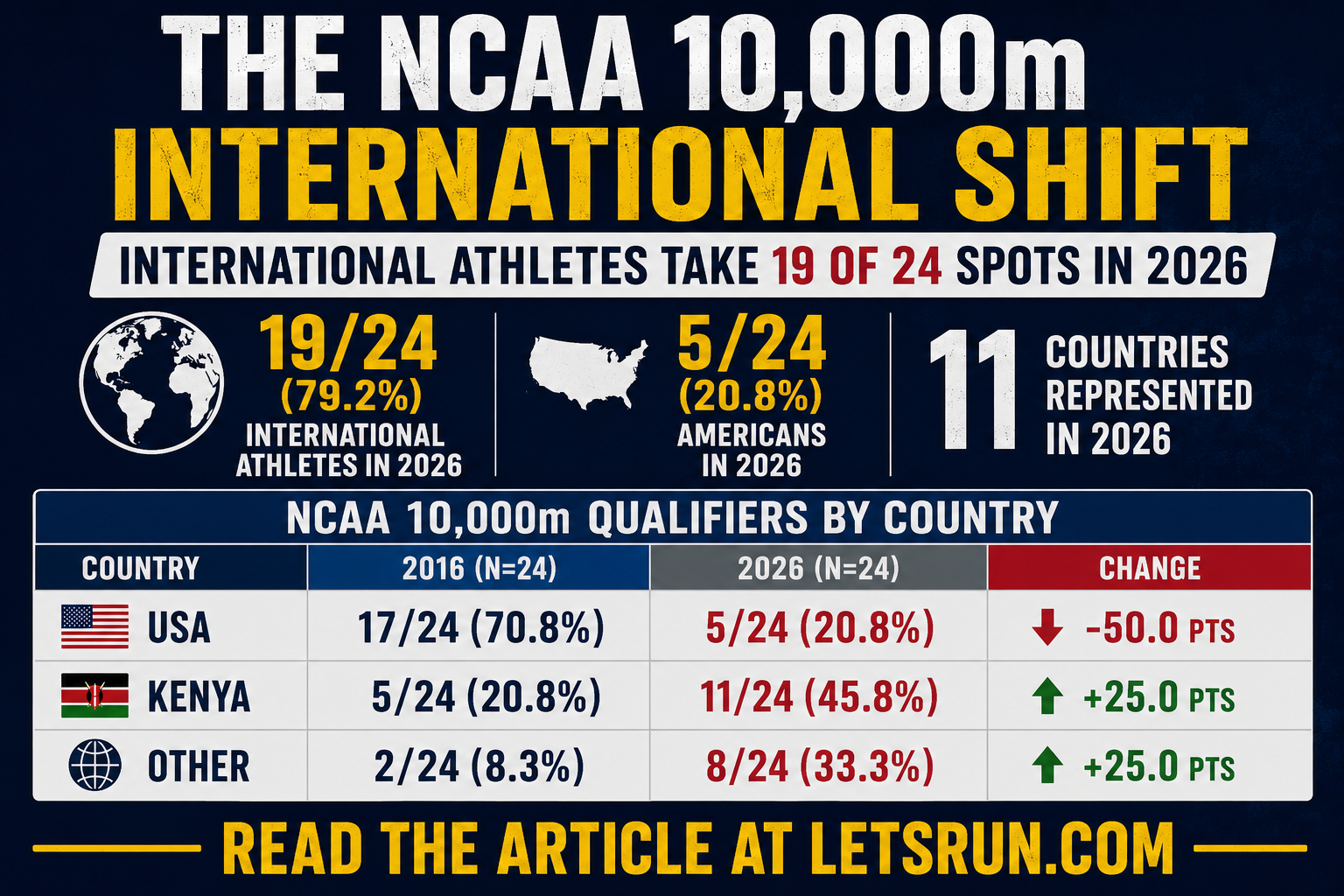
We’ve counted them up. Of the 24 NCAA 10,000m qualifiers, 19 of the 24 spots (79.2%) went to international athletes, leaving just five spots (20.8%) for Americans.
Here is the breakdown by regional. Of the 12 qualifiers from the West regional, only one is an American — Evan Jenkins of Washington.
Of the 12 qualifiers from the NCAA East regional, four are American.
NCAA East Men’s 10,000m Semifinalists (Top 12)
| Pl | Athlete | School [Class] | Nationality & Hometown | Age (as of May 2026) |
| 1 | Elsingi KIPRUTO | Louisville [FR] | 🇰🇪 Kenya (Nandi County) | 20 (Born Aug 19, 2005) |
| 2 | Dennis KIPRUTO | Alabama [JR] | 🇰🇪 Kenya (Eldoret) | 27 (Born Feb 2, 1999) |
| 3 | Kelvin CHERUIYOT | Florida [FR] | 🇰🇪 Kenya (Samitui) | 25 (Born Aug 31, 2000) |
| 4 | Dismus LOKIRA | Alabama [SO] | 🇰🇪 Kenya (Kapenguria) | 28 (Born May 7, 1998) |
| 5 | Zouhair REDOUANE | Tennessee [SO] | 🇲🇦 Morocco (Azilal) | 21 (Born Jan 2, 2005) |
| 6 | William ZEGARSKI | Butler [JR] | 🇺🇸 United States (Maineville, OH) | 22 (Born May 14, 2004) |
| 7 | Hudson HURST | Alabama [SR] | 🇺🇸 United States (Franklin, TN) | ~23–24 (HS Class of 2021) |
| 8 | Miguel BAIDAL | Eastern Kentucky [SR] | 🇪🇸 Spain (Alicante) | 24 (Born July 20, 2001) |
| 9 | Will ANTHONY | Virginia [JR] | 🇳🇿 New Zealand (Whitby, Porirua) | 22 (Born Aug 30, 2003) |
| 10 | Jacob NENOW | Princeton [SO] | 🇺🇸 United States (Portland, OR) | 21 (HS Class of 2023) |
| 11 | Charlie ORTMANS | Harvard [JR] | 🇺🇸 United States (Arlington, VA) | 21 (Born March 31, 2005) |
| 12 | Tomer TARRAGANO | North Carolina [SR] | 🇬🇧 United Kingdom (Birmingham, Eng) | 25 (Born Jan 4, 2001) |
So in total, of the 24 NCAA qualifiers this year in the men’s 10,000, 11 are from Kenya, five are from the United States, and eight other countries account for one qualifier each.
NCAA Qualifiers by Country
Kenya – 11
USA – 5
Canada – 1
Eritrea – 1
Great Britain – 1
Israel – 1
Morocco – 1
New Zealand – 1
South Africa – 1
Spain – 1
The number of international qualifiers has risen dramatically over the last decade. Ten years ago, at the 2016 NCAA Outdoor Track & Field Championships, 17 of the 24 (70.8%) NCAA 10,000m qualifiers hailed from the USA.
2016 NCAA 10,000 Qualifiers by Country
USA – 17
Kenya – 5
GBR – 1
Canada – 1
2016 NCAA Top 24 and country
1 Edward Cheserek JR Oregon 29:09.57 (Kenya)
2 Futsum Zienasellassie SR Northern Arizona 29:10.68 (USA via Eritrea)
3 Gabe Gonzalez SR Arkansas 29:11.09 (USA)
4 Pierce Murphy SR Colorado 29:12.49 (USA)
5 Reid Buchanan SR Portland 29:13.40 (USA)
6 Jacob Thomson SO Kentucky 29:13.73 (USA)
7 Luis Vargas SR North Carolina St. 29:18.40 (USA)
8 Erik Peterson JR Butler 29:23.48 (USA)
9 Lawrence Kipkoech SO Campbell 29:24.69 (Kenya)
10 Colin Bennie SO Syracuse 29:26.54 (USA)
11 Amon Terer SR Campbell 29:28.87 (Kenya)
12 Lane Werley SR UCLA 29:29.14 (USA)
13 Luke Traynor JR Tulsa 29:33.54 (GBR)
14 Ben Flanagan SO Michigan 29:35.85 (Canada)
15 Shaun Thompson SR Duke 29:37.41 (USA)
16 Connor McMillan SO BYU 29:40.65 (USA)
17 Reed Fischer SO Drake 29:41.47 (USA)
18 Antibahs Kosgei JR Alabama 29:42.89 (Kenya)
19 Jonathan Green SO Georgetown 29:44.42 (USA)
20 George Parsons JR North Carolina St. 29:48.76 (USA)
21 Charles Mathenge SR Stephen F. Austin 31:11.02 (Kenya)
22 Ryan Rutherford SR Illinois State 31:34.05 (USA)
23 Tyler King SR Washington 32:13.48 (USA)
24 Philo Germano SO Syracuse DNF (USA)
| NCAA 10,000 Qualifiers by Country | ||
| 2016 | 2026 | |
| USA | 17/24 (70.8%) | 5/24 (20.8%) |
| Kenya | 5/24 (20.8%) | 11/24 (45.8%) |
| Other | 2/24 (8.3%) | 8/24 (33.3%) |
What is driving the shift?
What explains this decade-long transformation? If that’s a question you are into, then I highly recommend you read this 2024 piece from my colleague Jonathan Gault: LRC Here’s Why There Are So Many Top Kenyan Runners in the NCAA This Year – Scholarbook & the New NCAA Math – LetsRun.com
While multiple factors are at play, including expanding global recruiting networks thanks to the internet, there was one major institutional change that added fuel to the fire. In 2023, the NCAA permanently eliminated standardized testing (SAT/ACT) requirements for initial Division I and Division II eligibility, shifting to a GPA-only model. Historically, navigating these American standardized exams was a massive friction point for international prospects.
What do you think? Join the conversation and share your thoughts on our forum at letsrun.com/forum:
👉 Discussion Thread: 79.2% (19/24) NCAA 10,000 qualifying spots go to international athletes
PakarPBN
A Private Blog Network (PBN) is a collection of websites that are controlled by a single individual or organization and used primarily to build backlinks to a “money site” in order to influence its ranking in search engines such as Google. The core idea behind a PBN is based on the importance of backlinks in Google’s ranking algorithm. Since Google views backlinks as signals of authority and trust, some website owners attempt to artificially create these signals through a controlled network of sites.
In a typical PBN setup, the owner acquires expired or aged domains that already have existing authority, backlinks, and history. These domains are rebuilt with new content and hosted separately, often using different IP addresses, hosting providers, themes, and ownership details to make them appear unrelated. Within the content published on these sites, links are strategically placed that point to the main website the owner wants to rank higher. By doing this, the owner attempts to pass link equity (also known as “link juice”) from the PBN sites to the target website.
The purpose of a PBN is to give the impression that the target website is naturally earning links from multiple independent sources. If done effectively, this can temporarily improve keyword rankings, increase organic visibility, and drive more traffic from search results.
